
- Creating and Publishing a Form
- Instant Forms
- Conversational Form
- Create Multi Step Forms In WordPress
- Using Calculations in SureForms: A Step-by-Step Guide
- Calculation Formula Guide
- SureForms Login Block – Step-by-Step Guide
- SureForms Registration Block – Step-by-Step Guide
- SureForms – PDF Generation Feature
- GDPR Compliant Forms
- Adjust Form Notification Emails
- Form Confirmation
- Entries Management Feature Guide
- How to Add Query Parameters to Form Redirects
- How to Fetch Query Parameters from URL
- Set the “From Email” in SureForms
- Setting Up “Reply-To” Email Using Form Input Tags – SureForms
- Restrict Form Entries in SureForms
- Form Scheduling in SureForms
- Conditional Confirmations in SureForms
- SureForms Integration with ActiveCampaign
- SureForms Integration with AgileCRM
- SureForms Integration with Airtable
- SureForms Integration with LatePoint
- SureForms Integration with FluentCRM
- Connect SureForms To Zapier
- Automate WordPress Forms with the Custom App Builder
- SureForms Integration with Telegram
- SureForms Integration with Breeze
- SureForms Integration with Brevo
- SureForms Integration with GetResponse
- SureForms Integration with Drip
- Integrating SureForms with OttoKit
- Webhooks
- Webhook Conditional Logic
- SureForms Integration with Salesflare
- SureForms Integration with Hostinger Reach
- SureForms Integration with MailPoet
- SureForms Integration with Mailchimp
- Conditional Logic with Integrations
- SureForms Integration with Zoho CRM
- SureForms Integration with MailerPress
- SureForms Integration with Google Sheets
- SureForms Integration with Notion
- Unable to Upload SureForms ZIP: File Unzipped On Download
- Browser Support for SureForms
- Not Getting Update Notifications
- How To Rollback to Previous SureForms Versions
- Publishing Failed: Invalid JSON Response
- Troubleshooting Email Sending In SureForms
- SureForm Submissions Marked as Spam – How to Fix
- API Request Failed – Nonce Verification Error
- Fixing the “Destination folder already exists” Error When Installing SureForms
- How to Set Up SureForms with Caching Plugins
- srfm_enable_redirect_activation
- sureforms_plugin_action_links
- srfm_quick_sidebar_allowed_blocks
- srfm_integrated_plugins
- srfm_suretriggers_integration_data_filter
- srfm_form_submit_response
- srfm_enable_gutenberg_post_types
- srfm_languages_directory
- srfm_form_template
- srfm_disable_nps_survey
SureForms Integration with Notion
This guide explains how to integrate SureForms with Notion at both the global and form levels. Using this integration, you can automatically create pages or add rows to Notion databases from SureForms submissions.
Global Settings
Step 1: Access SureForms Settings
- From your WordPress dashboard, navigate to SureForms → Settings.
- Click on the Integrations tab.
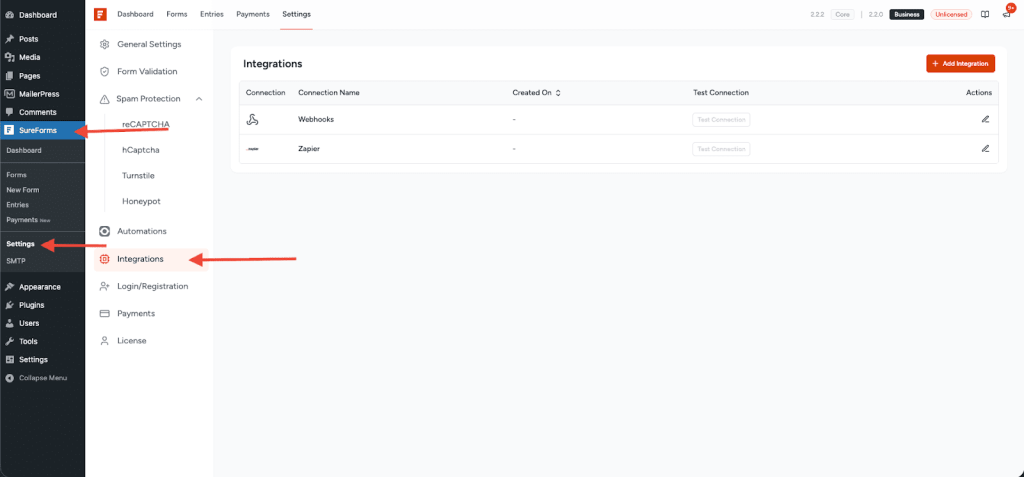
Step 2: Add Notion
- Click the Add Integration button.
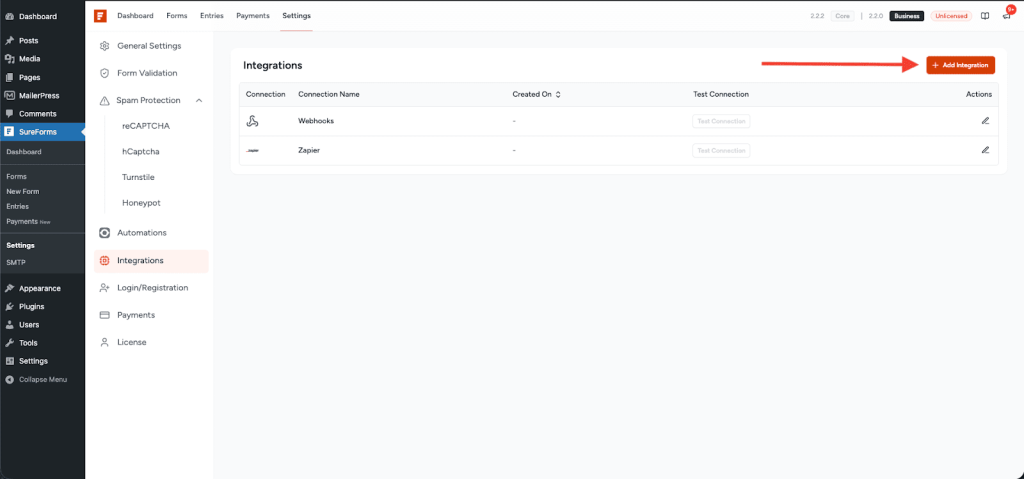
- From the list of available integrations, select Notion.
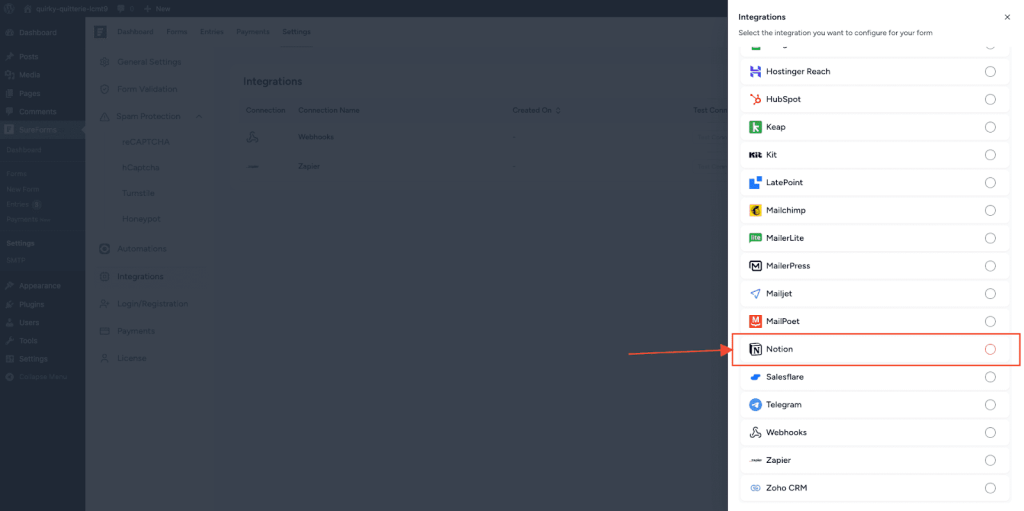
- You can also use the search bar to find it quickly.
Step 3: Connect Notion
The Notion integration requires an Integration Token to authenticate and connect SureForms with your Notion workspace.
How to Get a Notion Integration Token
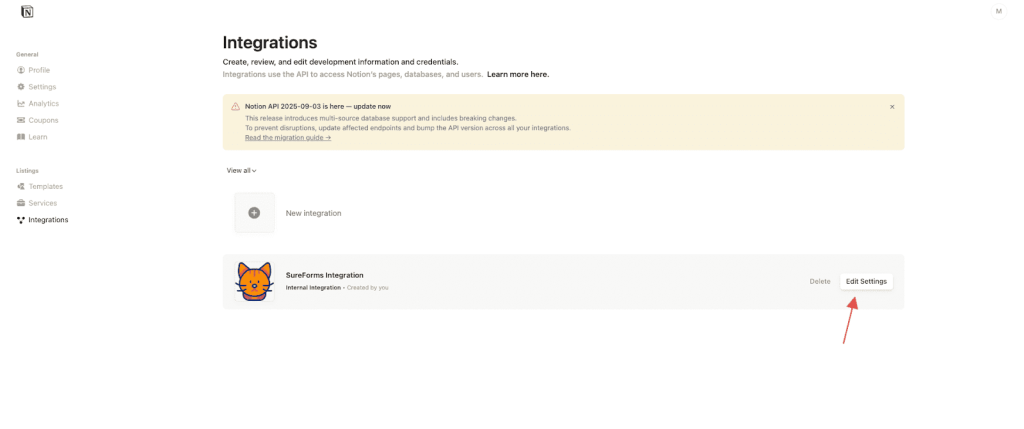
- Visit Notion → My Integrations.
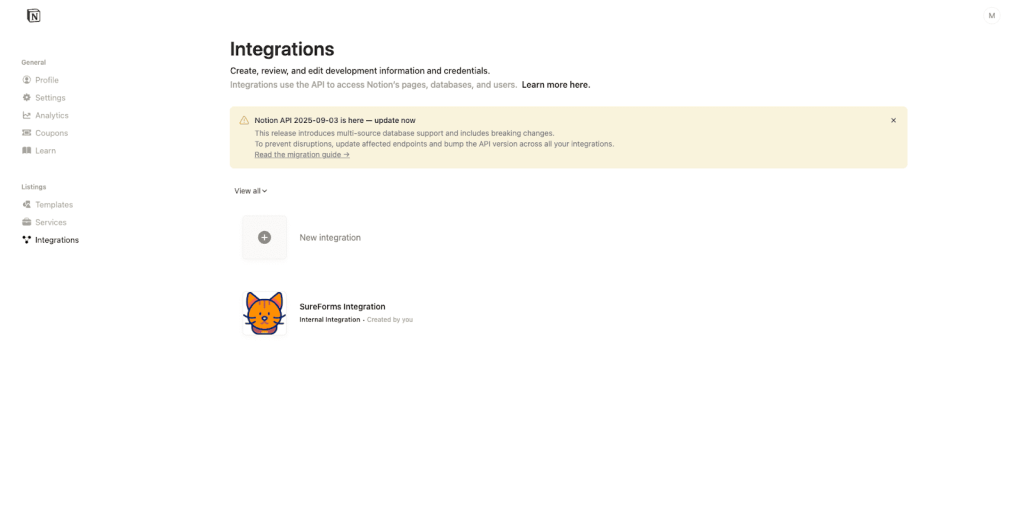
- Open an existing integration or click Edit Settings on a previously created integration.
- Locate the Internal Integration Secret.
- Click Copy to copy the token.
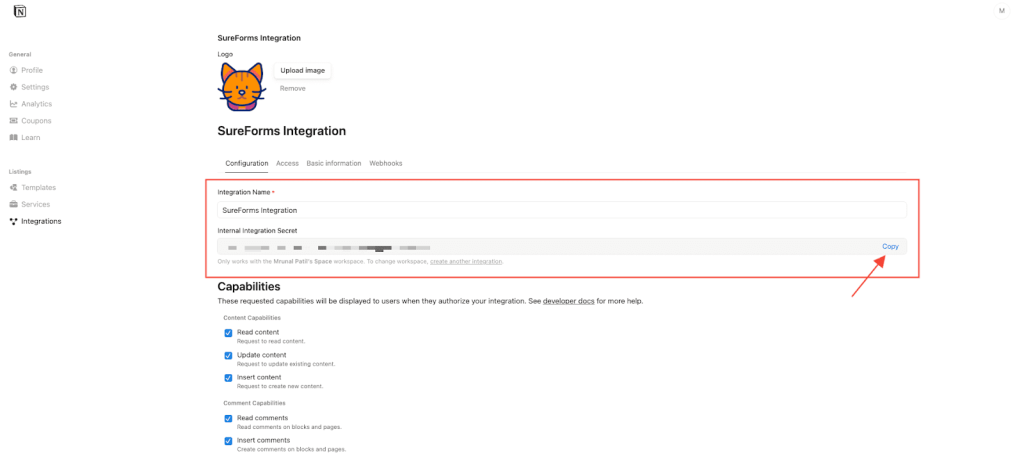
Important: Keep this token secure. Anyone with access to it can access the Notion pages and databases shared with this integration.
Step 4: Add the Token in SureForms
- Return to your WordPress dashboard.
- Navigate to SureForms → Settings → Integrations.
- Open the Notion integration.
- Paste the copied Integration Token.
- Click Connect.
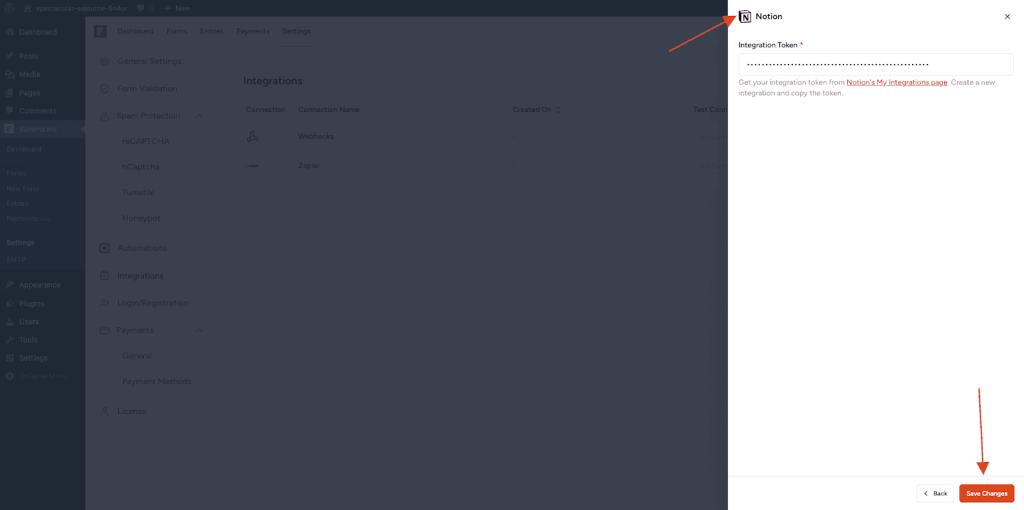
Once the connection is completed successfully, you’ll see the confirmation message:
Integration configured successfully!
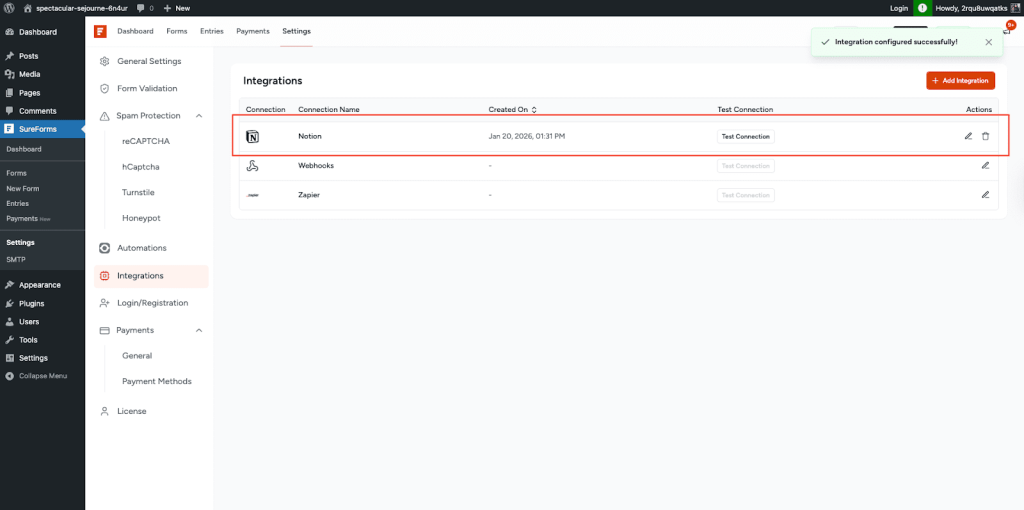
Notion will now appear in the list of global integrations.
Form Settings
Step 1: Open the Form Editor
- Go to SureForms → Forms from your WordPress dashboard.
- Open the form where you want to integrate Notion.
Step 2: Add Notion to the Form
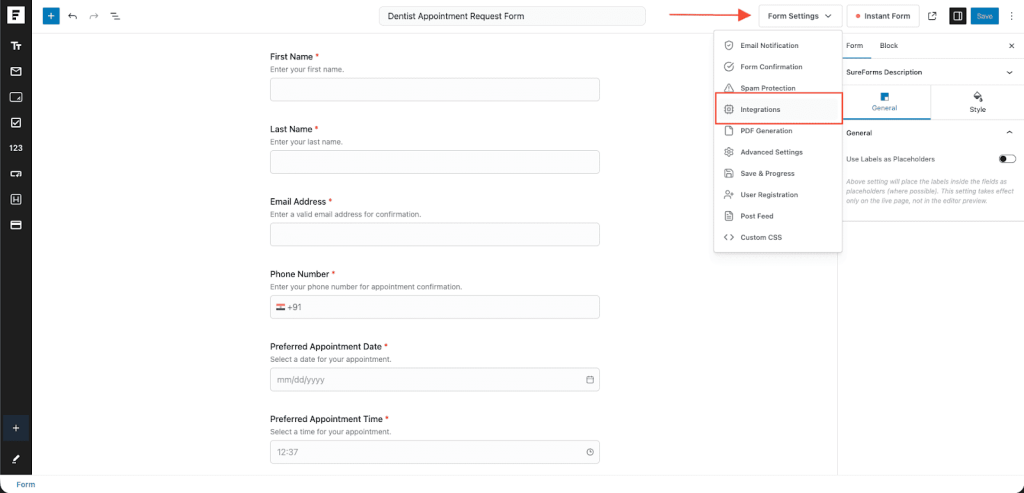
- Open the Integrations tab from the dropdown options.
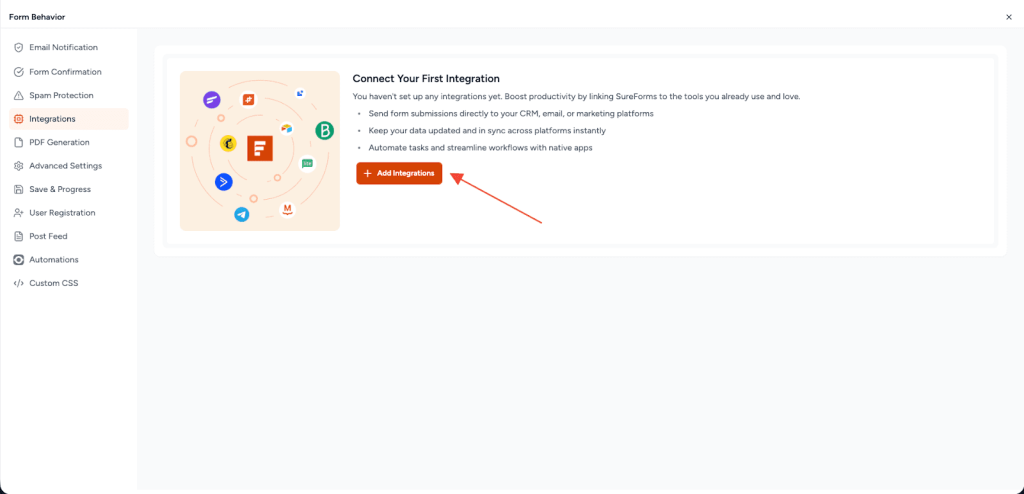
- Click Add Integration.
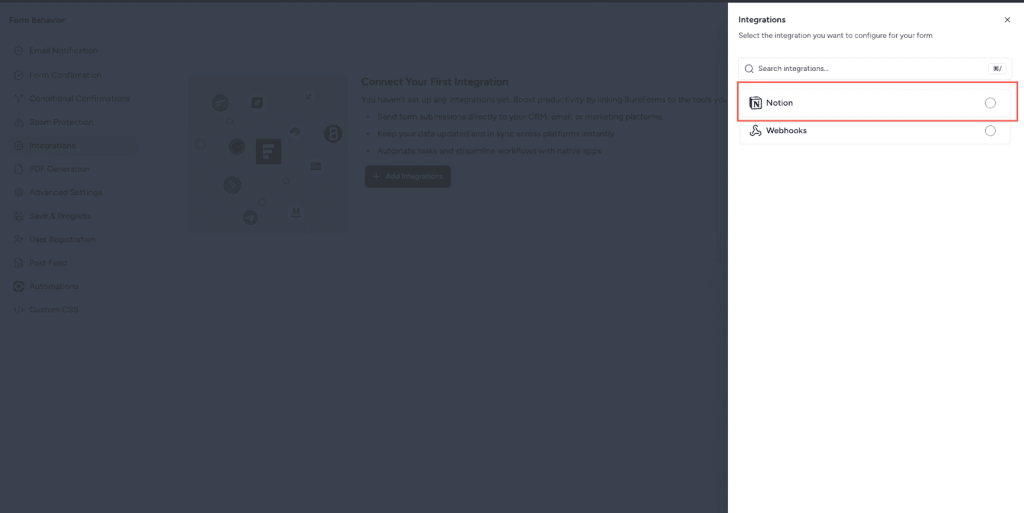
- Select Notion from the list of available global integrations.
Step 3: Configure Notion Integration
The Notion integration setup includes three tabs:
1. Select Tab
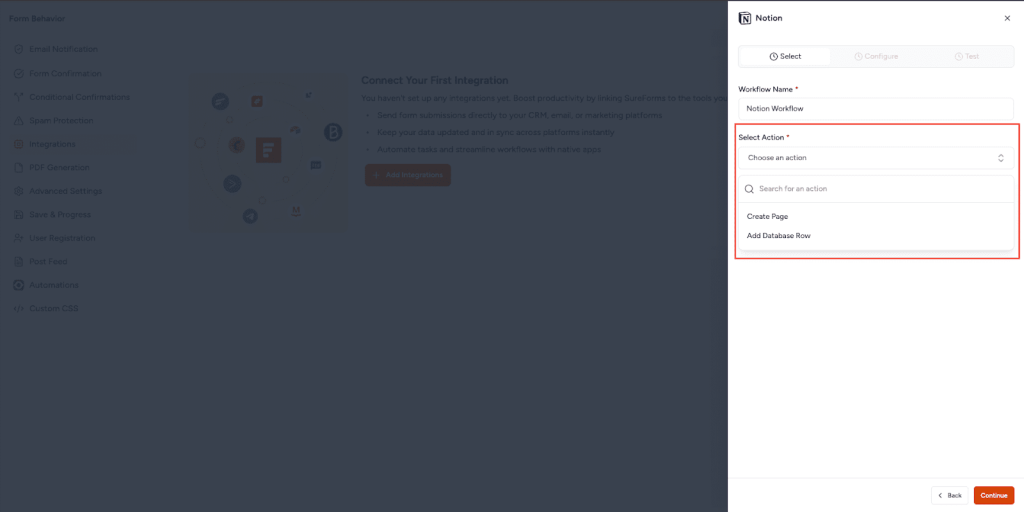
Provide the workflow details:
- Workflow Name – Required
- Action – Required
Available actions:
- Create Page
- Add Database Row
After selecting the desired action, click Continue.
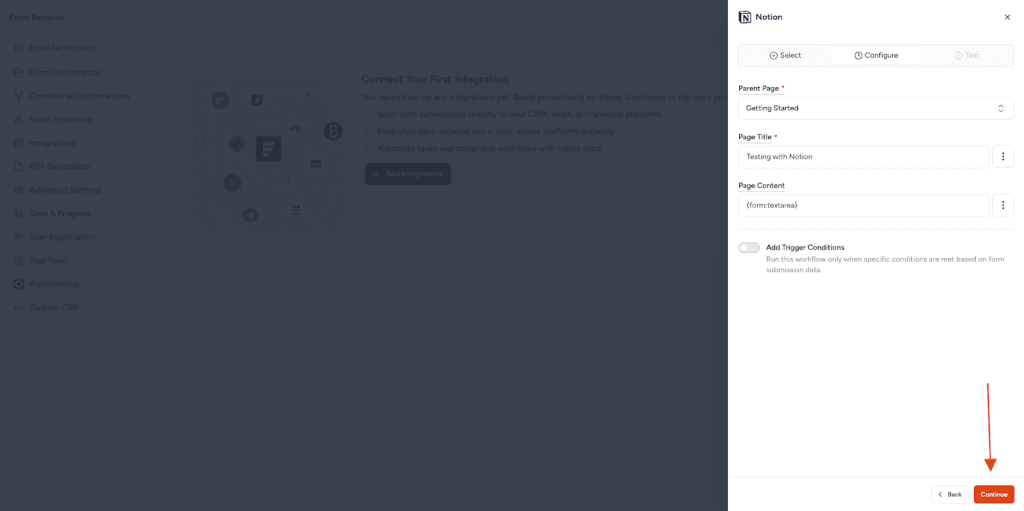
2. Configure Tab
Configuration options change based on the selected action.
Create Page
- Select the Parent Page in Notion where new pages should be created.
- Map SureForms fields to the page content (for example, title or text blocks).
- Optionally add static or custom content.
Each form submission will create a new page under the selected Notion parent page.
Add Database Row
- Select the Notion Database where the row should be added.
- Map SureForms fields to the corresponding database properties such as:
- Title
- Text
- Select
- Number
- Date
- Ensure all required database properties are mapped.
Each form submission will add a new row to the selected Notion database.
Click Continue once configuration is complete.
3. Test Tab
- Click Test Workflow to verify the integration.
- You’ll see a success message such as: <msg>
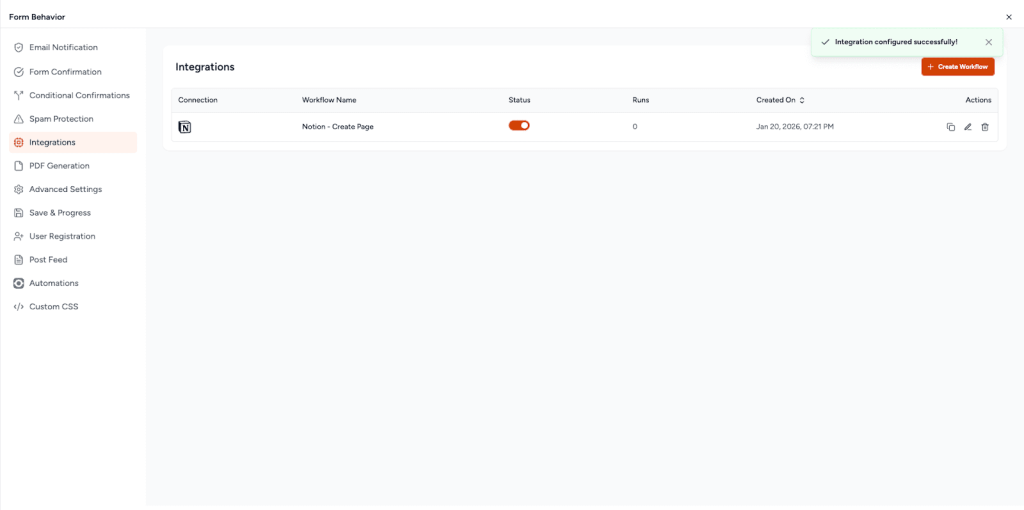
- Click Save Changes to apply the workflow.
Integration Complete
Your form is now successfully connected to Notion.
Based on the configured action, each form submission will automatically:
- Create a new page in Notion, or
- Add a new row to a Notion database.
This enables seamless data storage and workflow automation inside your Notion workspace using SureForms.
We don't respond to the article feedback, we use it to improve our support content.